
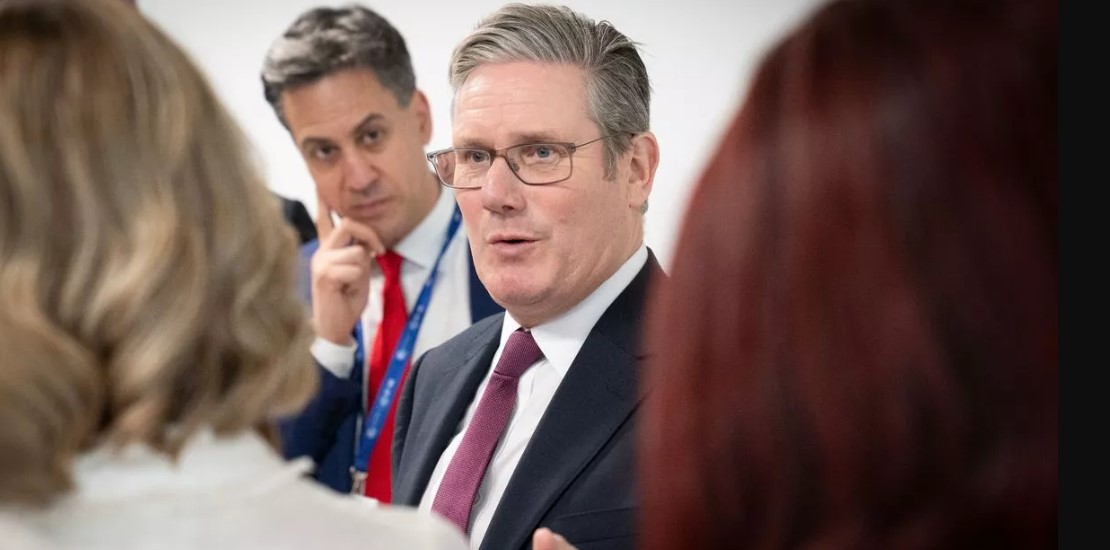
In recent months, Prime Minister Keir Starmer’s government has been highly active on the economic negotiation front, having reached agreements with India, the United States, and the European Union.
The British administration aims to revive the economy of what remains the world’s sixth-largest economic power by GDP. After a slow start to 2025, hopes are rising “with these quite promising trade agreements,” according to London.
The Challenge of Economic Recovery
Upon taking office at 10 Downing Street last July, Prime Minister Keir Starmer pledged to turn the page on the economic missteps of previous Conservative governments following the UK’s exit from the European Union. Five years after Brexit, and after six long months of tough negotiations with the EU, a mutually satisfactory agreement has finally been reached.
These negotiations covered nearly every aspect of economic life, including issues of security and the free movement of people and goods, all aiming for greater fluidity and fewer bureaucratic hurdles.
Key Aspects of the Agreement
Food and beverage controls will be simplified, and a new health and phytosanitary agreement has been negotiated to ease the burdens of importing and exporting between the two blocs. This will help avoid the long lines of trucks at borders, which have become a common sight since Brexit due to exhaustive checks.
British passport holders will be able to use electronic border gates (“eGates”) at EU borders, offering much-needed convenience.
The existing fishing agreement will remain in place for the next twelve years, with no increase in quotas.
On security and defence, the agreement allows the British defence industry to participate in SAFE, a European defence fund worth £150 billion, aiming to enhance Europe’s security.
Managing Channel Migration Flows
Another of Starmer’s campaign promises has also been addressed in this agreement, with a joint commitment to tackle illegal immigration. The goal is to better manage the flow of illegal migrants crossing the English Channel. Over the past year alone, an estimated 38,000 people made the crossing in small boats—a 22% increase compared to the previous year.
For the British government, this agreement with its main economic partner, the European Union, “will help reduce food prices, cut red tape, open access to the EU market, and inject nearly £9 billion into the British economy by 2040.”
Prime Minister Starmer stated that the deal is “good for jobs, good for public finances, and good for our borders… it will help boost the economy, support British jobs, and improve citizens’ incomes.”
Nick Thomas-Symonds, the UK’s chief negotiator and Minister for EU Relations, called it a “historic day, marking the beginning of a new chapter in our relationship with the EU, serving the workers of the United Kingdom.”
He emphasized that from the outset, the agreement aimed to enhance the security and prosperity of the British people, and that its three initial goals—securing jobs, ensuring safety, and protecting borders—have been achieved.
The Economic Prosperity Agreement
The agreement between the U.S. and the UK has also been met with satisfaction on both sides, according to official statements from London and Washington. Officially titled the “Economic Prosperity Agreement,” it was announced on the 80th anniversary of the end of World War II—the Allied victory over Nazi forces.
For the British, this first trade deal with the U.S. is seen as a safeguard for businesses and jobs. According to Prime Minister Starmer, it fulfills his promise to protect the steel and automotive industries, thereby saving thousands of jobs nationwide. For instance, British car exports to the U.S. reached £9 billion last year. Furthermore, U.S. tariffs on the automotive sector have been immediately slashed from 27.5% to 10%, and all tariffs on steel and aluminum have been lifted.
Britain’s struggling steel industry has been virtually saved thanks to these exemptions. In exchange, the UK has lifted all tariffs on U.S. ethanol, which is widely used in Britain’s manufacturing sector.
Another direct outcome of these negotiations is unprecedented access for British farmers to the American market, while maintaining protections for food standards.
As for the beef market, the agreement is considered a win-win, with reciprocal market access, all while upholding the UK’s high-quality food standards. Notably, some American farmers use growth hormones in beef production—a practice banned in the UK and EU since 1980.
The British Prime Minister declared, “Eight decades after the end of the Second World War, the United Kingdom has no greater ally than the United States.” He welcomed the fact that “under President Trump’s leadership, this special relationship remains an asset for our economy and national security. Jobs have been saved, jobs have been created, but the work is not done—our teams will keep working to strengthen this deal.”
British and American Satisfaction
On the American side, President Trump described the deal as opening the British market to an estimated $5 billion in exports from U.S. farmers, ranchers, and agricultural producers.
Negotiations are ongoing in the pharmaceutical sector. Ideally, the goal is to fully eliminate tariffs on both sides. Pharmaceuticals are a major UK export to the U.S., with sales last year reaching £6.6 billion. For the U.S., pharmaceuticals are the fourth-largest export to the UK, totalling around £4 billion.
The shared satisfaction stems from apparent agreement on three key objectives:
- Increasing the quality and volume of mutually beneficial trade between the United States and the United Kingdom.
- Removing barriers to facilitate business activity, investment, and trade between American and British companies.
- Ensuring that this special relationship is built on a sustainable, fair, and reciprocal economic partnership.
It’s worth noting that the agreement must still be debated in the U.S. Congress before its final approval, while negotiations continue to finalize remaining details.