
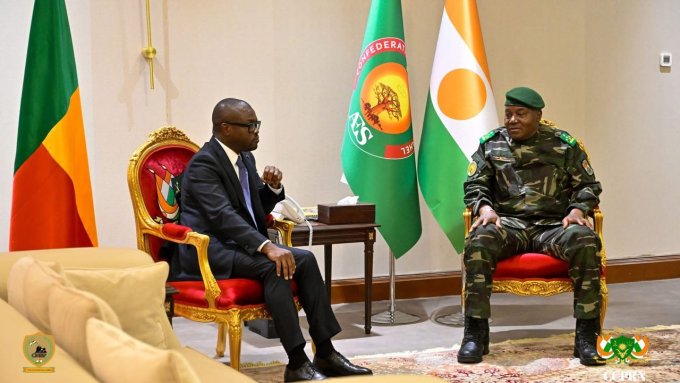
Less than ten days after officially assuming office as President of the Republic of Benin, Romuald Wadagni embarked on visits to his immediate neighbours. While his trip first took him to Nigeria, West Africa’s regional powerhouse, it was his visits to Niger and Burkina Faso that drew particular attention. Both countries are members of the AES (Alliance of Sahel States) and had maintained strained relations with the previous administration of Patrice Talon.
Reviving Trade Relations
In order to revitalise trade between Benin and its Sahelian neighbours—relations that have been under considerable strain for the past two to three years—it is evident that stronger coordination in tackling insecurity is essential.
In both Niamey and Ouagadougou, security cooperation and economic recovery featured prominently on the agenda during discussions between Wadagni and his Sahelian counterparts.
At Niamey, the first stop of this mini-Sahel tour, President Romuald Wadagni and General Tiani reaffirmed their shared commitment to combining efforts to combat the scourge of terrorism and banditry that has affected the sub-region for several years.
With this security principle clearly restated, the two heads of state then turned to economic recovery. According to the final communiqué issued at the close of the visit, the two presidents expressed their determination to work towards removing all obstacles to stronger bilateral cooperation, particularly through the reopening of the Benin–Niger border.
To translate these commitments into concrete action, a committee of experts has been established and given a fifteen-day mandate to identify and remove the remaining obstacles, before submitting its report to the two heads of state.
This development is set to transform relations between the two countries. It is worth recalling that, before its political crisis in 2023, Niger was Benin’s leading trading partner within ECOWAS. Following the change of regime in Niger in July 2023, the border with Benin was closed amid suspicions that French or ECOWAS troops might use Beninese territory to launch an incursion into Niger.
Even before the crisis, Niger accounted for nearly 37% of the goods transiting through Benin’s logistics platform, with volumes exceeding 175,000 tonnes and quarterly revenue estimated at 13.9 billion CFA francs.
On a daily basis, more than 1,000 trucks used the Port of Cotonou–Malanville–Niamey corridor. However, the crisis forced traffic away from this route onto a much longer detour through Nigeria, driving up logistics costs, slowing trade, and in turn weighing on Niger’s economy. Whereas goods travelling via the Beninese corridor typically took just two to three days, shipments routed through Nigeria could take as long as two to three months.
Romuald Wadagni’s visit, at the invitation of his Nigerien counterpart, General Tiani, is expected to revive efforts to ease tensions and restart economic and security cooperation between the two countries. This would provide a welcome boost to Niger’s economy, which needs renewed momentum to consolidate the economic gains achieved in recent years.
Sources: Anadolu Agency – Deutsche Welle – L’Économiste